Publications
21.05.2017 15:00 NEW PUBLICATIONS ON STUDIES OF RUSSIA AND RUSSIAN HYBRID WARFARE.
The Foreign Policy Research Institute of the Diplomatic Academy of Ukraine under the Ministry of Foreign Affairs of Ukraine offers a new edition on the present Russia-Ukraine war at the discretion of readers - the book by G.M. Perepelytsia “Ukraine - Russia: War in Terms of Coexistence”.
19.05.2017 21:00 Victor Hvozd*: Geopolitical Problems and Forecasts for the Arctic Region
One of the global impacts of the world economy is the aggravation of the international struggle for access to natural resources and key transcontinental transport routes. This issue is becoming of particular relevance as proven deposits of energy and minerals get exhausted, while freight and passenger flows grow.
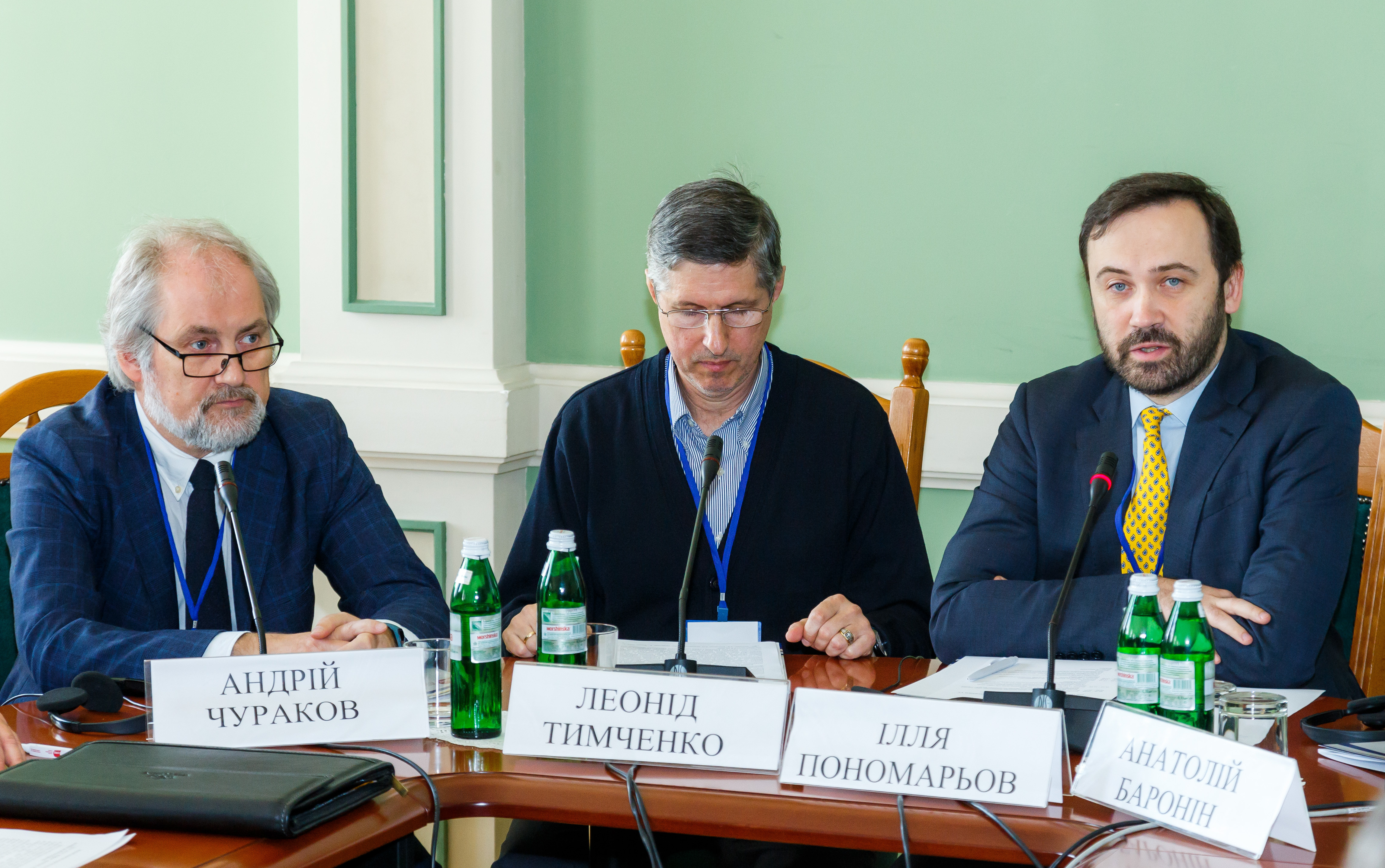
18.05.2017 21:00 Andrey Churakov*: Arctic Policy of Russia: Objectives, Directions, Practice
The increase of the interest to the Arctic region in recent decades has contributed to the emergence of a solid array of various kinds of governmental projects, plans, programmes, concepts, and hypotheses. The scientific community did not remain aloof from this problem, enriching the circumpolar science with an impressive library, which includes both publications devoted to highly specialized topics and general issues. The Arctic agenda is formed from four main plots in an established format, including the international level: the prospect of economic development of the Arctic shelf, the possibility of organizing new transport routes, protecting the environment, protecting the rights of indigenous small peoples inhabiting the Far North.
17.05.2017 19:00 Leonid Tymchenko*: International Legal Regime for the Arctic
The Arctic is a part of the globe with the North Pole as a nominal centre, which comprises waters of the Arctic Ocean and its seas and land areas of Europe, Asia, and America. So far there is no universally accepted definition of the term in geography and law. The issue of the southern boundary of the Arctic remains disputable, although many scientists are inclined to believe that it is the Arctic Circle (66 ° 33ʹ North latitude).
16.05.2017 23:11 Conference "Russian Activeness in the Arctic: goals, trends and security challenges" 12.05.2017




30.04.2017 20:00 Markian Chuchuk *: Tatarstan in the Federal System of Russia, Support or a Time Bomb?
The issue of the place and role of the Republic of Tatarstan in the Russian federal system is extremely complex and multidimensional; its consideration requires an integrated approach. In addition to the federal aspect in case of Tatarstan, there is a number of other contexts, without full understanding of which it would be impossible to tackle with the problem. Since the Republic of Tatarstan is a national republic of the Russian Federation, it is important to take into account the historical and political circumstances, national and ethnic aspects. It is equally important to consider the civilizational and religious aspects, not only in the regional dimension, but also in view of contradictory processes of globalization. Tatarstan holds a special position in the Russian federal system and is the only entity which retains in its Constitution reference to sovereignty and statehood, institutes of citizenship and presidency of the Republic.
30.04.2017 19:00 Larisa Pylhun * Deepening Economic Crisis in Russia: How Long will Socio-Political "Stability" Last?
Predicting socio-political processes in neighbouring countries is usually a tool of preventing and/or mitigating certain events and making the most out of any situation. Predicting socio-political processes in Russia is a major security issue not only for Ukraine and many other countries, but for the population of Russia itself. Danger for other countries is reflected in the annexation of the Crimea; war in eastern Ukraine; shooting down Dutch airliner, etc. The danger for the population of Russia is in the political repressions of opposition and extrajudicial reprisals; mass violence from the part of law enforcement authorities regarding the population; large probability of a full-scale war in which people will be the main victim. A most important issue of the forecast at the end of 2016 is: how long the socio-political "stability" of Russia will last, what impact it will have on its citizens and how the "stability" would affect relations with other countries.
30.04.2017 18:00 Maryna Stavniychuk*: Specific Features of the Federal Structure of Russia: Is the Russian Federation a True Federation?
David Lewis, modern English political analyst, made a serious caveat in one of his latest articles “The Moscow Consensus: Constructing Autocracy in Post-Soviet Eurasia” in the OpenDemocracy edition – “in much of the former Soviet Union, authoritarianism has become the default political system, informed by a remarkably unified set of ideas about the world, the state, and about politics and society, that resonate among elites.”[1] It is customary to be called "the Moscow consensus" in political and legal sciences. Its norms and values, in my opinion, are one of the major problems for liberal democracy to which we aspire throughout our region.
17.04.2017 21:52 Dr. Cristian Atland[1]*: Is Russia a threat to the Arctic and Baltic flank of NATO[2]
Military intervention of Russia to the Crimean Peninsula in February-March 2014, further illegal annexation of the Crimea and Sevastopol, and military intervention of Russia to the unsolved conflict in the East of Ukraine resulted in considerable deterioration of Russia’s relations with the West, and created a new security situation in Europe. Putin’s efforts to challenge the established post-Cold War European security order and change internationally recognized borders by means of military force and non-conventional means led to uncertainty that comes far beyond the post-soviet territory. After Russian intervention to the Crimea, NATO had to review a lot of aspects of its relations with Russia. The Alliance has also initiated a range of measures related to strengthening military security of its eastern countries-members, namely, the Baltic States, Poland and Romania. Further to the North, the most northern member of NATO – Norway – observes with the increased vigilance the events development in Russia. The same related to non-aligned Sweden and Finland that tried to adapt to the development and the growing complexity of the security environment in the northern Europe.